Course:
HIGH-STRESS BREATHING

When people are told to “take a deep breath,” there’s a natural temptation to fill the lungs with as much air as possible. 😮💨
But when we’re trying to slow things down, bigger isn’t necessarily better.
The Reset Breath is about breathing gently, slowly and comfortably — not taking enormous breaths or forcing your lungs to work harder.
Think of your breathing like turning down the volume on a radio. 🔉
You’re not trying to suddenly switch everything off.
You’re simply turning things down a little.
Your breathing should feel:
You should still be getting enough air to feel comfortable.
The aim is simply to reduce the pace without forcing the breath.
Imagine someone tells you:
🗣️ “Quick! Relax! Take a HUGE breath!”
You might immediately do this:
It might look like controlled breathing, but repeatedly moving more air than your body needs can sometimes have the opposite effect to what we’re trying to achieve.
Instead, think:
🌬️ Enough air to feel comfortable — no more than you need.
Over-breathing means breathing more air than your body currently needs.
This can happen by breathing:
💨 Too quickly
😮 Too deeply
🔁 Or both at the same time
For some people, over-breathing can lead to sensations such as:
If you’re trying a breathing exercise and begin feeling uncomfortable, don’t force yourself to continue.
Return to your normal breathing and allow yourself to settle.
This is one of the most important ideas in this module.
Instead of telling yourself:
Try thinking:
That’s a small change — but an important one.
We’re controlling the pace, not competing to see who can take the biggest breath! 🏆🫁
When comfortable, breathing gently through your nose can be a useful way to practise the Reset Breath. 👃🌬️
But again…
If breathing through your nose isn’t comfortable — perhaps because you’re congested or for another reason — don’t force it.
The technique should work with you, not against you.
While practising, occasionally ask yourself:
Great — keep going.
Ease off a little.
Stop the exercise and return to your normal breathing.
The goal isn’t to push through discomfort.
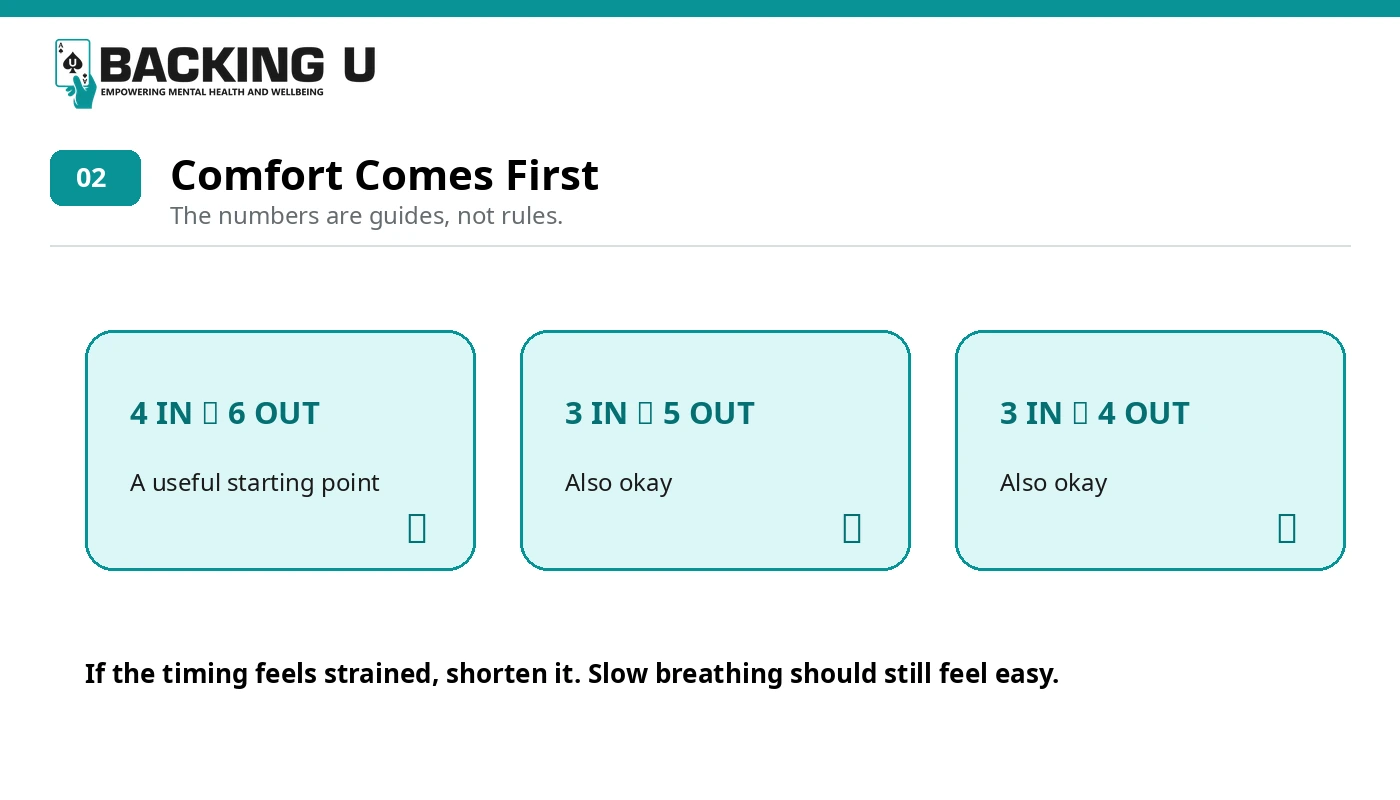
You don’t need the 4–6 rhythm just yet.
For the next three breaths, simply notice your breathing.
Notice the difference between forcing a big breath and simply allowing yourself to breathe a little more slowly.
That’s the feeling we’re looking for. 🎯
Force huge breaths • Race your breathing • Push through discomfort • Worry about being perfect
Breathe gently • Slow the pace • Stay comfortable • Adjust when needed
🫁 The Reset Breath isn’t about how MUCH air you can breathe — it’s about slowing your breathing while keeping it comfortable.
In the next lesson, we’ll put this into practice by introducing your first breathing rhythm:
And remember: the numbers are a guide, not a test. ⏱️🌿