
Course:
HIGH-STRESS BREATHING

Breathing happens automatically — most of the time, you don’t even notice you’re doing it.
But when you’re feeling stressed, under pressure or tense, your breathing can change. It may become faster, shallower or less comfortable without you consciously deciding to breathe that way.
Learning to deliberately slow things down gives you a simple tool you can use almost anywhere when you need a moment to reset and regain your composure. 🧘
There are plenty of breathing techniques out there — some simple and some surprisingly complicated!
For our Reset Breath, we’re keeping things simple.
Research into regulated breathing has found some of the strongest and most consistent stress-related evidence around slow-paced breathing.
So we’re starting with one basic idea:
🌿 Slow your breathing down, keep it comfortable, and give yourself a moment to reset.
You don’t need complicated breathing patterns. You don’t need to hold your breath for ages. And you definitely don’t need to see how much air you can possibly squeeze into your lungs!
Slow + Gentle + Comfortable = Reset. 🌬️
Think about the last time you were really under pressure.
Maybe you were running late. ⏰
Dealing with an argument. 😤
Preparing for something important. 📋
Or suddenly faced with a difficult situation.
Your body may have responded before you even had time to think about it.
You might notice:
These can all occur when your body becomes more alert.
Here’s where breathing becomes particularly useful:
💡 Breathing happens automatically — but you can also deliberately change it.
That means your breathing gives you something simple to focus on when everything else feels like it’s speeding up.
This part is important.
When someone says:
What’s the first thing most people do?
They suck in the BIGGEST BREATH POSSIBLE! 😮💨
But that’s not the goal of the Reset Breath.
Repeatedly taking unnecessarily large breaths can leave some people feeling light-headed or uncomfortable.
Instead, we want breathing that feels:
Don’t concentrate on getting more air.
Concentrate on finding a slower, comfortable rhythm.
Everyone is different.
A breathing speed that feels completely comfortable for one person might feel too slow for someone else.
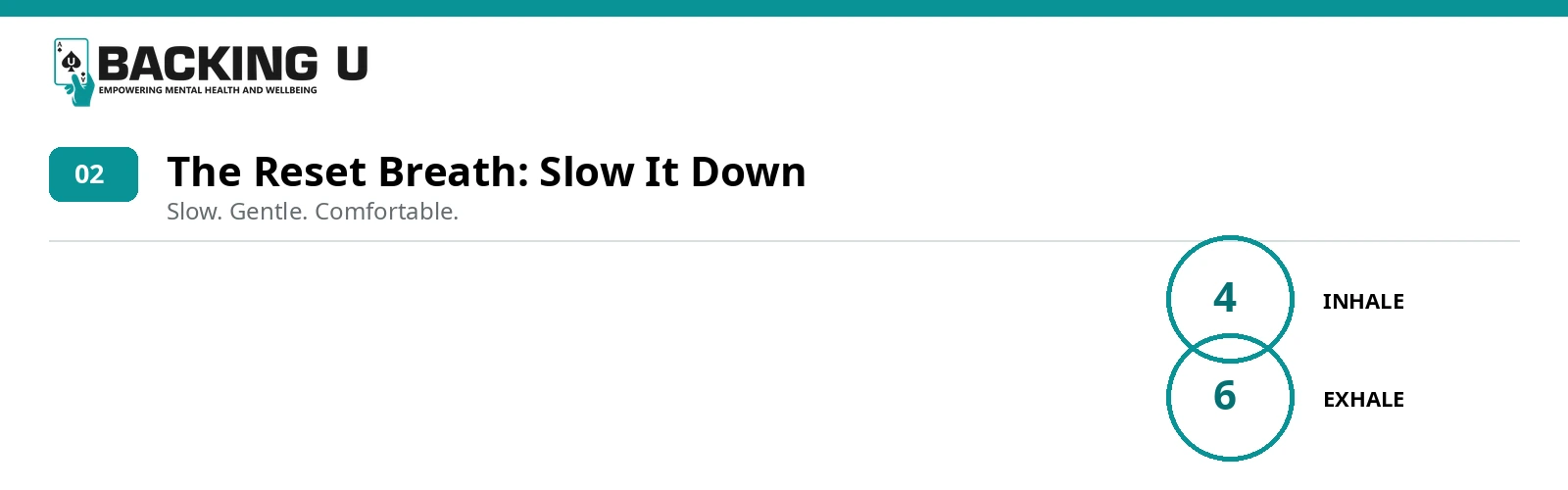
Later in this module, you’ll learn a simple breathing rhythm:
But those numbers are a guide — not a test.
If four seconds feels too long, shorten it.
If a six-second exhale feels uncomfortable, shorten that too.
🚫 Don’t force your breathing just to beat the timer.
The goal is to become slower and more comfortable, not to achieve a particular number.
Take enormous breaths • Hold our breath for ages • Force a breathing rhythm • Get the timing “perfect”
Slow down • Stay comfortable • Breathe gently • Find our own rhythm
The first principle of the Reset Breath is incredibly simple:
🌬️ Don’t try to breathe MORE. Try to breathe more SLOWLY and COMFORTABLY.
Next, we’ll look at why bigger isn’t always better and how to avoid accidentally over-breathing before learning the full 4-in / 6-out Reset Breath. 🫁✨


