
Course:
HIGH-STRESS BREATHING

nn
Stress can change breathing before we consciously realise that we are stressed.
A difficult conversation, unexpected news, pressure at work, financial concerns, conflict, fear or even a thought about something that might happen can activate the body’s stress response. Sometimes the first sign that stress is building isn’t an obvious feeling of anxiety — it is a change in the way we breathe.
You might notice that your breathing becomes faster, your breaths become larger, you start sighing repeatedly, your chest feels tight, your shoulders rise or you develop the sensation that you cannot quite get a satisfying breath.
These reactions can feel uncomfortable or even frightening. However, they can be part of the body’s normal response to perceived threat.
Breathing is unusual because it happens automatically, but we can also influence it deliberately.
You don’t need to think about every breath you take. Your brain and nervous system continuously adjust your breathing according to what your body needs.
When your brain detects potential danger or significant stress, your body can move into a state of increased alertness. Your heart rate may increase, your muscles can become more tense and your breathing may change.
This response is not necessarily a problem.
In a genuinely dangerous situation, these changes can help prepare you to respond quickly.
The challenge occurs when the body continues responding as though something needs immediate action, even when you are physically safe.
For example:
Stressful thought → body detects threat → breathing changes → physical sensations increase → you notice the sensations → you become more concerned → stress increases further
This can create a cycle that feels difficult to break.
The purpose of breathing exercises is not to tell your body that stress is “bad” or to force yourself to become calm immediately.
Instead, we are learning to develop another response.
🌿 “I can notice what is happening in my body, and I can choose how I respond.”
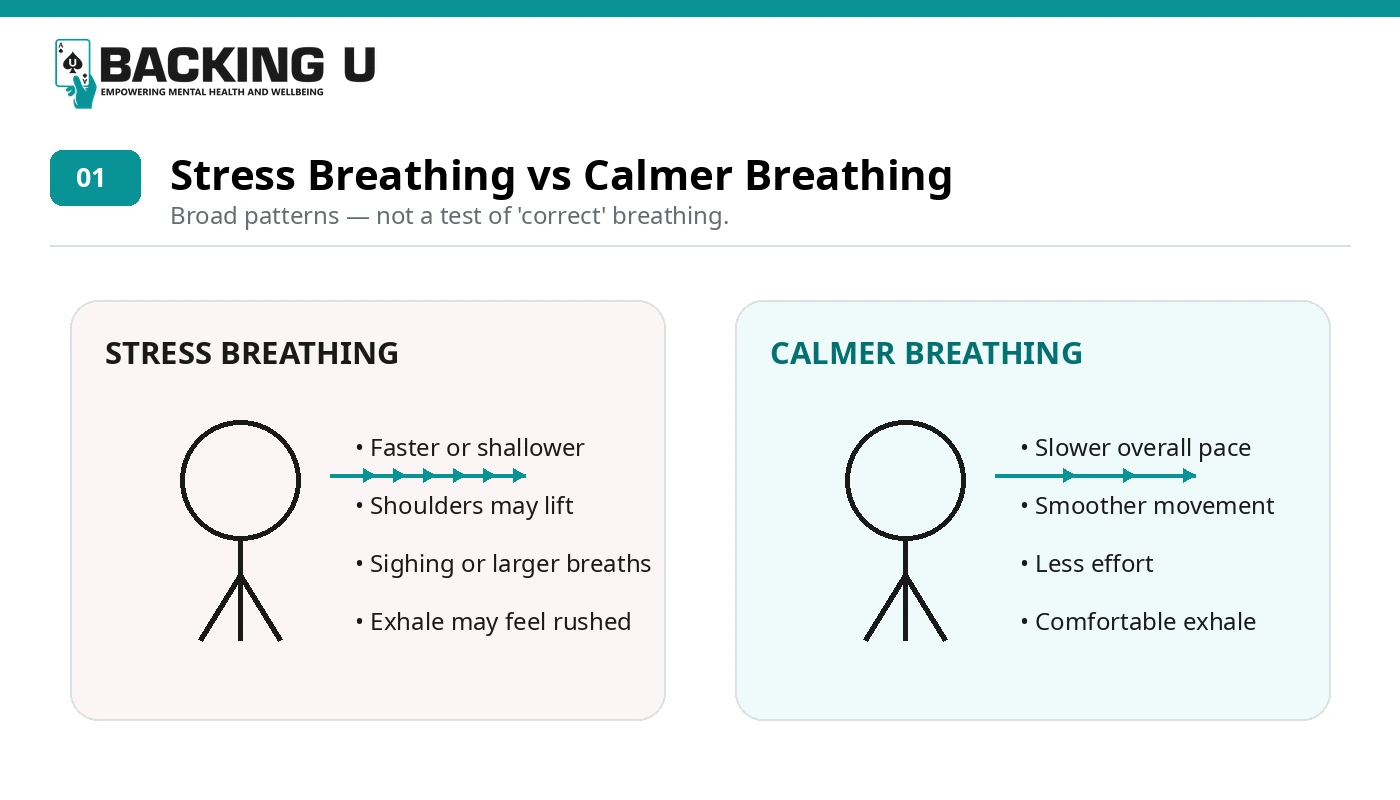
There isn’t one single “stress breathing pattern.” Different people respond differently, and the same person may breathe differently depending on the situation.
You may notice:
Your breathing rate may increase without you consciously deciding to breathe faster.
Some people respond to stress by taking bigger breaths or repeatedly trying to “get more air.”
Interestingly, repeatedly taking very large breaths can sometimes increase uncomfortable sensations rather than resolve them.
You might notice yourself sighing, yawning or taking occasional large breaths throughout the day.
Stress can cause the muscles around the chest, neck and shoulders to become tense. This can make breathing feel restricted or uncomfortable.
You may begin breathing through your mouth rather than your nose, particularly when breathing becomes faster or more forceful.
Some people unconsciously hold their breath during concentration, tension or anticipation.
You might notice yourself holding your breath while reading an email, waiting for a response, working under pressure or having a difficult conversation.
One of the most distressing sensations can be feeling as though you cannot quite complete a satisfying breath.
This can lead to repeatedly trying to take a bigger breath — which may then increase awareness of breathing and physical sensations.
One of the most important concepts in this course is understanding that breathing and stress can influence each other.
Imagine you’re sitting at work and receive an unexpected message.
You read it and immediately think:
“What’s this about?”
Your body reacts.
Your shoulders tense.
Your breathing changes.
You notice your chest feels tight.
You think:
“Why can’t I get a proper breath?”
You take a very large breath.
You still don’t feel satisfied.
You take another.
Now you’re paying even more attention to your breathing.
The physical sensations become more noticeable.
You become more concerned.
And the stress response increases.
This doesn’t mean that anything is “wrong” with you.
It means your attention, thoughts, physical sensations and nervous system are interacting.
Understanding this process can be incredibly useful because awareness gives you an opportunity to interrupt the cycle.
Before learning techniques designed to change your breathing, we’re going to develop a simpler skill:
This might sound easy, but it can be surprisingly difficult.
Most of us rarely pay attention to how we breathe until something feels unusual.
The first exercise in this course is therefore not about changing your breathing.
It is about observing it.
Think of yourself as a curious scientist rather than a critic.
You aren’t trying to decide whether you’re breathing “correctly.”
You’re simply gathering information.
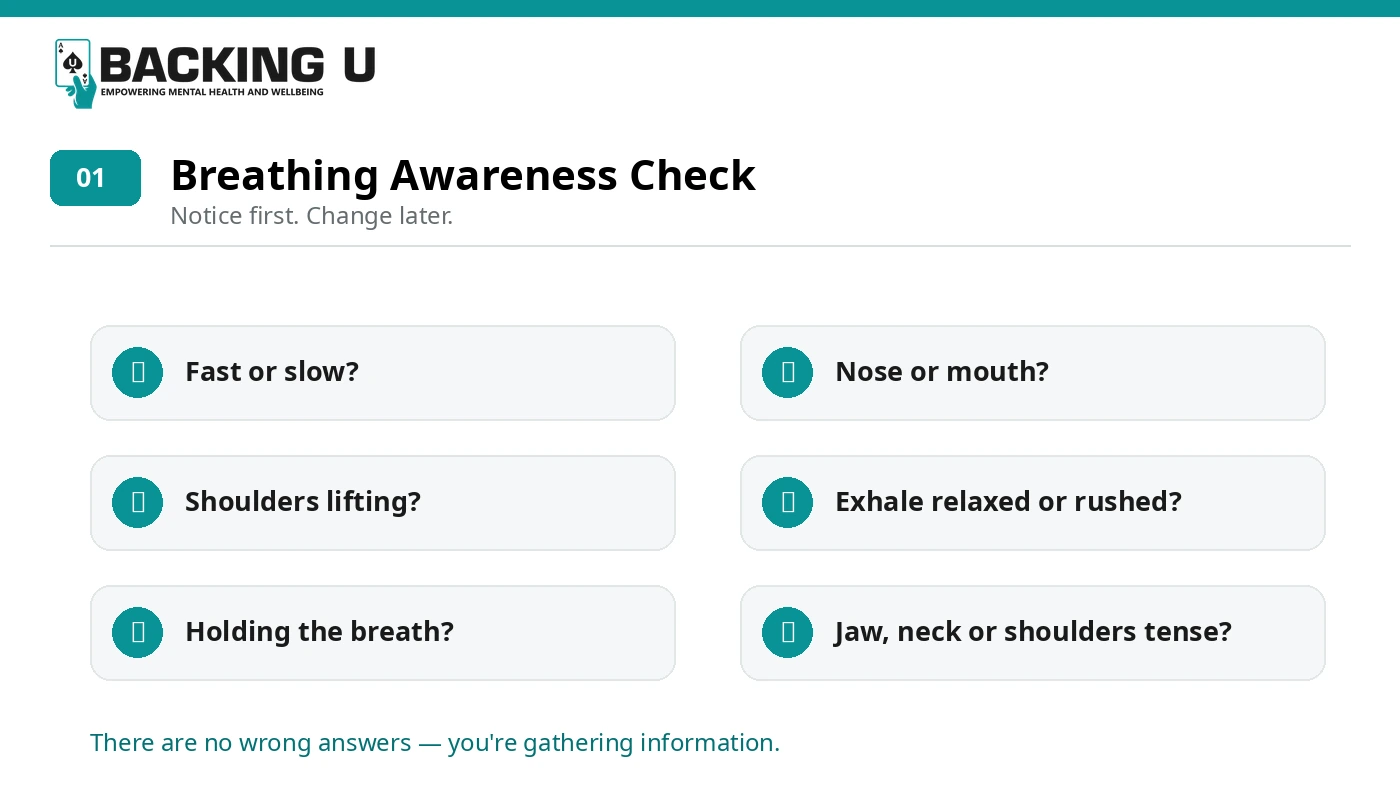
🌬️ Is my breathing fast or slow?
👃 Am I breathing mostly through my nose or mouth?
🫁 Does the movement seem to come mostly from my chest, ribs or abdomen?
🙆 Are my shoulders lifting when I breathe in?
😬 Are my jaw, neck or shoulders tense?
💨 Does my exhale feel relaxed or rushed?
⏸️ Am I holding my breath at any point?
😮💨 Am I repeatedly taking large breaths or sighing?
🧠 What happens to my breathing when I think about something stressful?
There are no “wrong” answers.
You are simply learning what your breathing currently looks and feels like.
It can be tempting to judge what you notice.
“I’m breathing too fast.”
“I’m doing this wrong.”
“I need to fix my breathing.”
Try replacing those thoughts with:
“I’m noticing that my breathing is faster right now.”
That small change matters.
You are moving from judgement → observation.
The objective is not to immediately control every aspect of your breathing. It is to recognise what is happening so that you can eventually make intentional changes when they are useful.
nPractical Exercise
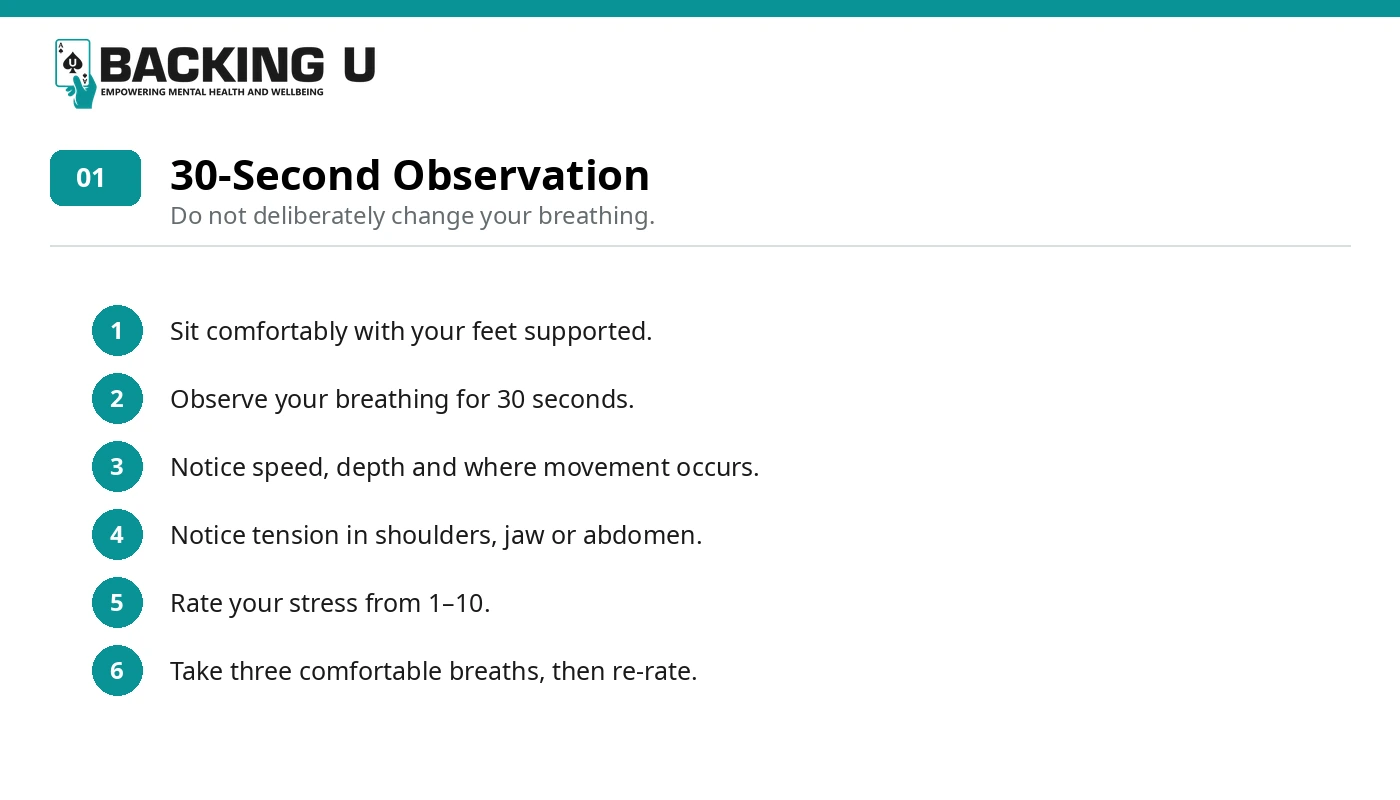
1. Sit comfortably with your feet supported.
2. Do not deliberately change your breathing for the first 30 seconds.
3. Notice the speed, depth and location of your breathing.
4. Notice whether your shoulders, jaw or abdomen are tense.
5. Give your current stress level a score from 1–10.
6. Take three comfortable breaths without trying to make them unusually deep.
7. Re-score your stress level.


